
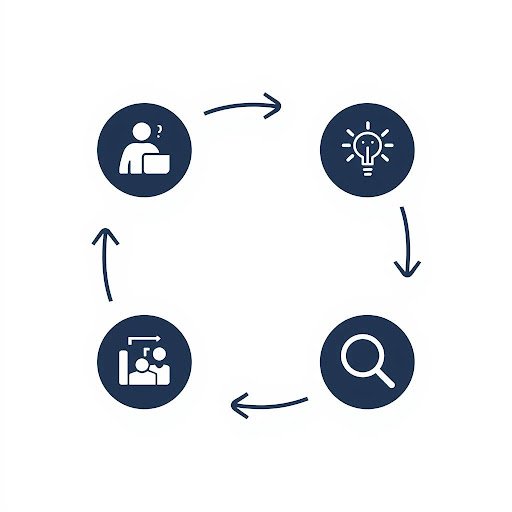
You have probably come across Gibbs' Reflective Cycle before. You may even know its six stages. But knowing the model is one thing. Using it in a CIPD assignment is another.
The confusion usually starts when you have to write your own reflection.
What belongs under Feelings? How much should you say in Description? And how do you make the Analysis section analytical rather than just telling the story of what happened?
Gibbs' Reflective Cycle gives you a clear way to work through an experience. The important thing is understanding what each stage is asking you to do.
Let’s see how it works, stage by stage.
What Is Gibbs' Reflective Cycle?
Gibbs' Reflective Cycle is a framework that helps you reflect on an experience in a structured way. Developed by American sociologist and educational researcher Graham Gibbs in 1988 in his book Learning by Doing, it breaks reflective practice into six distinct stages:
For CIPD students, this approach can be useful when an assignment asks you to reflect on workplace experience, professional behaviour or your own development.
CIPD encourages people professionals to reflect on learning, recognise development gaps, seek feedback and consider how their learning will change their future practice.
The 6 Stages of Gibbs' Reflective Cycle
1. Description – What happened?
Start with the actual situation.
Maybe you supported a manager during a disciplinary meeting. What happened? What was your role? What was the main issue?
Give the reader enough background to understand the situation, but do not spend half your reflection describing the meeting. Keep the details relevant. You need room for what you thought, how you responded and what you learned.
2. Feelings – How did you feel?
This is about your reaction to what happened.
You may have felt nervous about speaking up or worried about saying the wrong thing. If those feelings affected your actions or decisions, explain that briefly.
Keep it relevant to the experience. It should not read like a personal diary.
3. Evaluation – What went well and what did not?
Look at the experience honestly.
You may have stayed professional and kept accurate notes. But perhaps you were too hesitant to raise a concern.
Mention both. A positive outcome does not mean everything went well. Think about what worked and what you could have handled better.
4. Analysis – Why did it happen?
For many students, this is the hardest part of the model.
You have already explained what happened. Now you need to make sense of it.
Why did you respond in that way? What influenced the situation? What knowledge, theory or evidence can you use in your HR assignment to understand it?
A simple way to approach this is:
For example, you could connect the disciplinary situation to fair process, communication, employee relations or professional behaviour. You could then use relevant research, HR theory, workplace policy or CIPD guidance to support your points.
The CIPD Profession Map covers areas such as evidence-based practice, situational decision-making and self-awareness. These can help you analyse your workplace experience from a professional HR perspective.
The depth you need will also depend on your qualification. A CIPD Level 3 assignment may require a more straightforward application of ideas, while a CIPD Level 5 or CIPD Level 7 assignment may require more developed analysis and critical thinking in line with the assessment requirements.
5. Conclusion – What did you learn?
Now step back and identify the main lesson.
You might realise that you need to prepare more carefully before difficult employee meetings. You may also recognise that you need more confidence when raising concerns with managers.
Do not simply repeat what happened. Focus on what the experience taught you about your own knowledge, skills or professional practice.
6. Action Plan – What will you do differently?
This is where your reflection should lead somewhere.
Instead of writing, “I will improve my communication skills,” be more specific.
For example:
“Before my next disciplinary meeting, I will review the organisation's procedure, prepare questions in advance and ask my manager for feedback afterwards.”
Now there is a clear action to take. You can also come back to it later and see whether you actually followed through.
Summary of Gibbs' 6 Stages
Here is a quick reference table showing what each stage involves and how to target it in your coursework:
| Stage | Guiding Question | Focus in CIPD Assignments | Common Pitfall |
|---|---|---|---|
| 1. Description | What happened? | Concise factual overview of the workplace scenario and your role. | Writing too much story and running out of word count for analysis. |
| 2. Feelings | How did you feel? | Your emotional response and how it influenced your actions. | Turning the section into an unstructured personal journal. |
| 3. Evaluation | What went well and what didn't? | Balanced judgement of positive aspects and areas needing improvement. | Claiming everything went perfectly or focusing solely on negatives. |
| 4. Analysis | Why did it happen? | Linking your experience to HR theories, policies, and the CIPD Profession Map. | Merely re-describing events without academic or theoretical links. |
| 5. Conclusion | What did you learn? | Summary of key personal insights and professional skills acquired. | Repeating the description instead of identifying key takeaways. |
| 6. Action Plan | What will you do differently? | SMART targets for continuous professional development (CPD). | Making vague statements like "I will be more confident." |
Gibbs' Reflective Cycle Example for a CIPD Assignment
Imagine you supported a manager during a disciplinary meeting. The discussion became confrontational, but you did not feel confident enough to raise your concern.
Description: I supported my manager during a disciplinary meeting, taking notes and assisting with the process.
Feelings: I felt uncomfortable as the conversation became tense and was unsure whether to speak up.
Evaluation: I remained professional and kept accurate notes, but I could have prepared better and raised my concern appropriately.
Analysis: The experience showed me that confidence alone is not enough in HR. I also need to understand the relevant procedure and use evidence when raising concerns.
Conclusion: I learned that better preparation would help me respond more confidently in difficult situations.
Action Plan: For future meetings, I will review the relevant procedure, prepare questions and ask for feedback afterwards.
Notice that the example does not simply describe the meeting. It moves from the experience to learning and future action, making the reflection far more useful for an assignment.
Struggling With Your CIPD Reflective Practice Assignment?
Our CIPD-qualified writers help you craft deep, evidence-based reflective accounts that meet assessor criteria across Levels 3, 5, and 7.
Gibbs vs Kolb Reflective Cycle
Gibbs and Kolb are both commonly used for reflection. Their structures are different, though.
Gibbs' Reflective Cycle has six stages: Description, Feelings, Evaluation, Analysis, Conclusion and Action Plan. It gives you a clear structure for looking back at an experience and deciding what to do differently.
Kolb's Reflective Cycle has four stages: Concrete Experience, Reflective Observation, Abstract Conceptualisation and Active Experimentation. It focuses more on how an experience turns into learning and how you apply that learning in practice.
For CIPD students, either model can be useful. The right choice depends on your assignment brief and what you need to reflect on. If your brief focuses heavily on live decision-making, you might also compare these models with the Schon Reflective Model (reflection in action vs reflection on action).
| Criteria | Gibbs' Reflective Cycle | Kolb's Experiential Cycle |
|---|---|---|
| Number of Stages | 6 stages | 4 stages |
| Emotional Dimension | Explicitly evaluates feelings and psychological reactions. | Focuses primarily on cognitive processing and observation. |
| Primary Focus | Retrospective evaluation of a specific critical incident. | Continuous cycle of learning through experimentation. |
| Best For CIPD Units | 5CO03 reflective accounts, interpersonal conflict, CPD reviews. | Learning & development (L&D), training design, behavioural shifts. |
5CO03 Reflective Account
With a 5CO03 reflective account, the focus is on you — how you handled something at work, what it showed you about your way of working, and what you took from it.
It could be a difficult conversation, a team problem or a work decision. Focus on what you learned from it and what you would do differently next time.
A useful way to shape your reflection is:
Gibbs' model can give you a structure to follow, but your account should still sound personal and stay connected to your own professional development.
How to Use Gibbs' Cycle in a CIPD Assignment
Before you start writing, look at your assessment criteria. Your reflection should answer what the task is actually asking you to demonstrate.
Keep these points in mind:
- Do not let Description take over the assignment: Keep it concise so you have adequate words left for analysis.
- Use Analysis to connect your experience with evidence and HR practice: Integrate relevant CIPD Profession Map core behaviours and HR principles.
- Explain your own decisions instead of giving a general HR answer: The examiner wants to see your personal reflection, not a generic textbook definition.
- Use references where you make academic or theoretical points: Academic backing elevates your work from casual thought to critical reflection.
- Make your Action Plan specific and realistic: Formulate tangible steps you can monitor and evaluate over time.
- Check that your reflection matches the requirements of your CIPD level and unit: Tailor the depth of evaluation to Level 3, 5, or 7 standards.
If you understand Gibbs' model but still feel stuck on your CIPD assignment, cipdassessment.com can help you understand your brief and what you need to write.
We support CIPD students across Levels 3, 5 and 7 with practical help to structure their assignments and meet the assessment requirements.
Frequently Asked Questions
Yes, if your assessment requires reflective practice. Check your brief and assessment criteria first.
There is no fixed word count. Follow your assignment requirements rather than dividing words equally.
Yes, when you bring in theories, research, professional guidance or other academic ideas. Your own experiences and reflections do not usually need a citation.
Yes. Reflective writing is about your own experience, so using “I” is usually fine. Just follow your unit’s writing guidance.
Go beyond what happened. Explain why it happened, what you learned from it and how it may affect your future HR practice.