
If you are tackling an assignment on continuous professional development, you have almost certainly been asked to use the Schon reflective model. To truly understand Donald Schon reflective practice, we have to look beyond basic retrospective thinking. The Schon reflective practice model is unique because it specifically focuses on reflection in action and on action.
Referring to the Schön reflective model 1983 publication, this framework is a staple for CIPD Level 3, 5, and 7 students. Why? Because for L&D, CPD, and HR practice examiners want to see how one is able to handle real-time workplace challenges, not just how you write about them after weeks.
What Is the Schon Reflective Model?
The Schon reflective model is a continuous learning framework designed to capture how professionals think and adjust during live situations. Rather than just looking back at past events, the Schon model of reflective practice argues that actual learning happens through a mix of on-the-spot adjustments and post-event analysis.
Introduced in his seminal text, The Reflective Practitioner (1983), the core argument of the Schön reflective model is that professionals do not learn strictly from textbook theory. You learn by reflecting during and after the actual practice.
This makes the Donald Schön reflective model professionally relevant to many fields where things change by the minute, like HR professionals, L&D practitioners, nurses, teachers, and social workers. In the CIPD context, this model underpins the Continuing Professional Development (CPD) requirements across all qualification levels. In fact, Schon (1983) remains one of the most cited works in professional education literature on Google Scholar as of 2026.
Who Was Donald Schon?
Knowing more about the founder helps to grasp the initial concept of Donald Schon reflective practice. Donald Schon published The Reflective Practitioner: How Professionals Think in Action in 1983. He was an American philosopher and a professor at MIT. His main concept challenged the old-school idea to simply memorize textbook theories and then apply them in real world situations. Rather not very knowledgeable of the fact that real life situations are far different and messier than imaginable.
His work is now widely cited across CIPD, nursing, education, and social work academic literature. If you check the Schön reflective model Google Scholar metrics today, his 1983 text has accumulated tens of thousands of citations, cementing it as one of the most referenced theories in professional learning.

The Two Stages: Reflection in Action vs Reflection on Action
Here are the two phases of Schon's model:
- Stage 1 — Reflection IN Action: This is thinking on your feet. It is adjusting your behavior while the experience is actively happening. A classic reflection in action Schon example is an HR manager noticing that an employee is getting defensive during a disciplinary meeting, and instantly adjusting their tone mid-sentence to de-escalate the tension.
- Stage 2 — Reflection ON Action: This is your retrospective analysis. It happens after the dust has settled. You think about what happened to inform your future practice. For example, a trainer reviewing what went wrong in a morning learning session and planning improvements for the afternoon cohort.
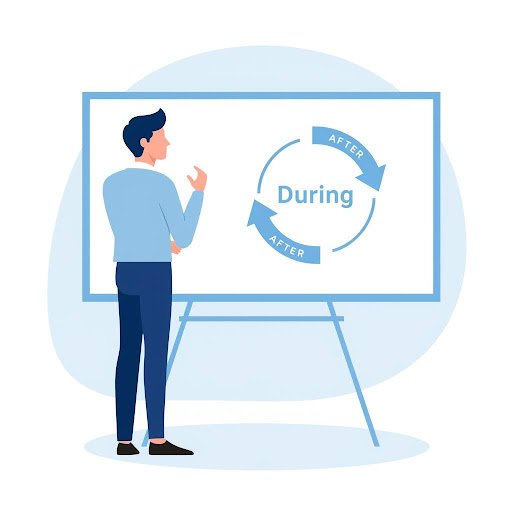
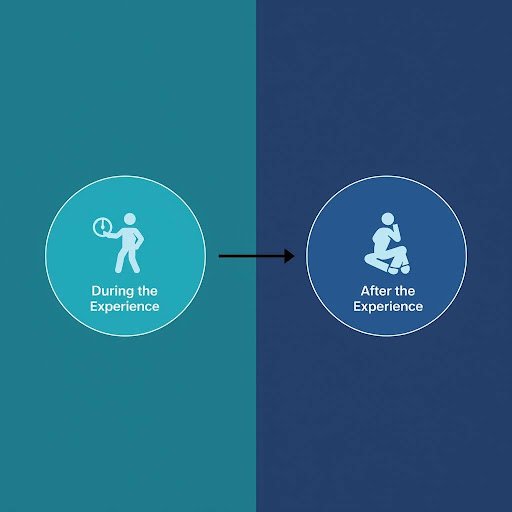
It is important to remember its timing when you are discussing reflection in action and on action. Most traditional models only focus on after-the-fact thinking. Schon reflection in action uniquely captures the in-the-moment brainwork that expert practitioners naturally use. Together, these two stages form a continuous Schon reflective cycle.
Schon Reflective Model Stages Explained
To properly apply the Schon reflective model, you need to know exactly what is expected of the practitioner at each phase. Here is how the Schön reflective model stages break down:
| Stage | Name | When It Happens | What the Practitioner Does |
|---|---|---|---|
| 1 | Reflection IN Action | During the experience | Adjusts thinking and behavior in real-time based on live feedback. |
| 2 | Reflection ON Action | After the experience | Figure out what happened, evaluating successes and failures and plan improvements. |
Diving a bit deeper into Schon's reflective model:
- Stage 1 requires you to access your "knowing in action", your automatic, muscle-memory professional knowledge, and consciously question it while you are in the middle of a task.
- Stage 2 of Schon's reflection model is your structured retrospective analysis. What worked? What didn't? What to do differently next time?
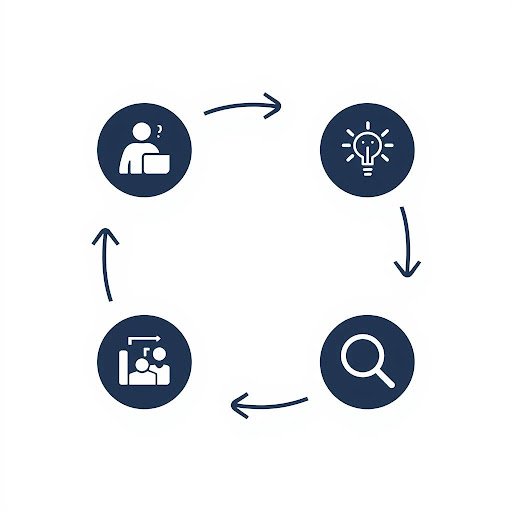
It's a circular flow: Experience → Reflection IN → Adjusted Action → Reflection ON → Improved Practice.
Schon Reflective Model vs Other Reflective Models
How does the Schon model of reflection stack up against the other big names? The Schon reflective model is distinct, and picking the right one for your assignment is critical.
| Model | Stages | Focus | Best Used For |
|---|---|---|---|
| Schon (1983) | 2 (in/on action) | Real-time + retrospective | Professional practice reflection |
| Gibbs | 6 stages | Structured retrospective | Assignment-based reflection |
| Kolb | 4 stages (cycle) | Experiential learning cycle | Training and L&D design |
| Johns | 5 guided cues | Structured self-questioning | Healthcare and HR reflection |
The Key Takeaway: Schon is the only model that explicitly captures in-the-moment professional thinking.
If you are writing a structured assignment response, Gibbs is often easier. However, if your brief asks how professionals actually think and adjust during live practice, especially common in advanced qualifications, Schon is the superior choice.
Need to understand what examiners look for at different levels? Check out our guides on CIPD Level 5 Assignment Help and CIPD Level 7 Assignment Help.
How to Apply the Schon Reflective Model in CIPD Assignments
Applying the Schon reflective practice model effectively can be the difference between a pass and a merit. A common trap is simply describing what happened without isolating the real-time adjustments. Donald Schon reflective practice demands specific academic formatting. Here is how to nail the Schon reflective model in your next paper:
- Identify the situation: Pick a specific professional situation or workplace experience you are reflecting on.
- Describe your reflection IN action: What adjustments did you make in the moment? What was your actual thinking process while the event was unfolding?
- Describe your reflection ON action: What did you analyze after the event was over? What would you do differently next time?
- professional standards linking: Tie your reflection directly to CIPD professional behaviors or L&D outcomes as required by your specific assignment brief.
- Cite correctly: Always cite Schon (1983) correctly, referencing The Reflective Practitioner, as the theoretical framework underpinning your analysis. Do not rely on secondary summaries.
- Connect to your CPD: Explain clearly how this reflection will directly improve your future professional practice.
Struggling to Write This in Your Assignment?
Our CIPD-qualified writers apply Schon's framework correctly across Level 3, 5, and 7 every day — with the right citations, structure, and distinction-level analysis.
Struggling to translate this into an essay? Our expert writers at CIPD Assignment Help UK apply Schon’s framework correctly across all levels and subjects every single day.
An Example Of Schon Reflective Model in HR and L&D Practice
Sometimes, seeing Schon's reflective model in action is the easiest way to understand it. Here are two practical examples.
HR Example: The Performance Review
- Reflection in action: An HR manager is performing a yearly evaluation. During the discussion they notice the worker has their arms crossed and gives defensive answers. The manager quickly notices this. Changes their questioning style using a different tone and asking more open questions.
- Reflection on action: Later while the HR manager was going over the meeting notes they figured out why the employee was being defensive. The HR then chose to revise the evaluation system for upcoming sessions to ensure that expectations are more clearly defined from the start.
L&D Example: The Training Session
- Reflection in action and on action work perfectly here. A trainer notices participants checking their phones and disengaging during a heavy slideshow presentation. So he cuts the presentation short and switches to a group discussion exercise. After the session is complete he reviews the curriculum design, and permanently alters the content structure for the next delivery cohort.
(CIPD Tip: Always use a real workplace scenario from your own practice for maximum marks. Examiners value authenticity over generic hypotheticals!)
Strengths and Limitations of the Schon Reflective Model
Like any framework, the Schon reflective model has its pros and cons. Understanding both shows critical thinking, which is vital for high marks.
Strengths
- It uniquely captures real-time professional thinking, no other standard model does this.
- It is universally applicable to any dynamic professional context (HR, L&D, healthcare, social work).
- It aligns perfectly with CIPD's CPD framework.
- It is grounded in actual expert practitioner behavior, rather than just academic theory.
- It is widely cited and highly credible.
Limitations
- Unlike Gibbs or Johns, it is not very structured, therefore it becomes harder to apply steps in an assignment without clear guidance.
- Schon's Model mostly relies on memory and honest remembering of events making documentation a hard task.
- It also does not have a list of questions to guide beginners through the reflective process.
- Most people see this model as a form of self-reflection which may ignore the systematic factors of an organisation.
Need Our Help for Your Assignment?
If you are struggling to properly integrate the Schon reflective model into your paper or with any assignment help then you aren't alone.
Our team of CIPD-qualified writers knows exactly how to apply Donald Schon reflective practice across Level 3, 5, and 7 assignments. We clearly distinguish between your reflection IN and ON action, which is the number one marking criterion examiners look for.
Stop stressing over your CPD requirements. We offer work free of plagiarism with multiple revisions within the comfort of your assignment deadline.