
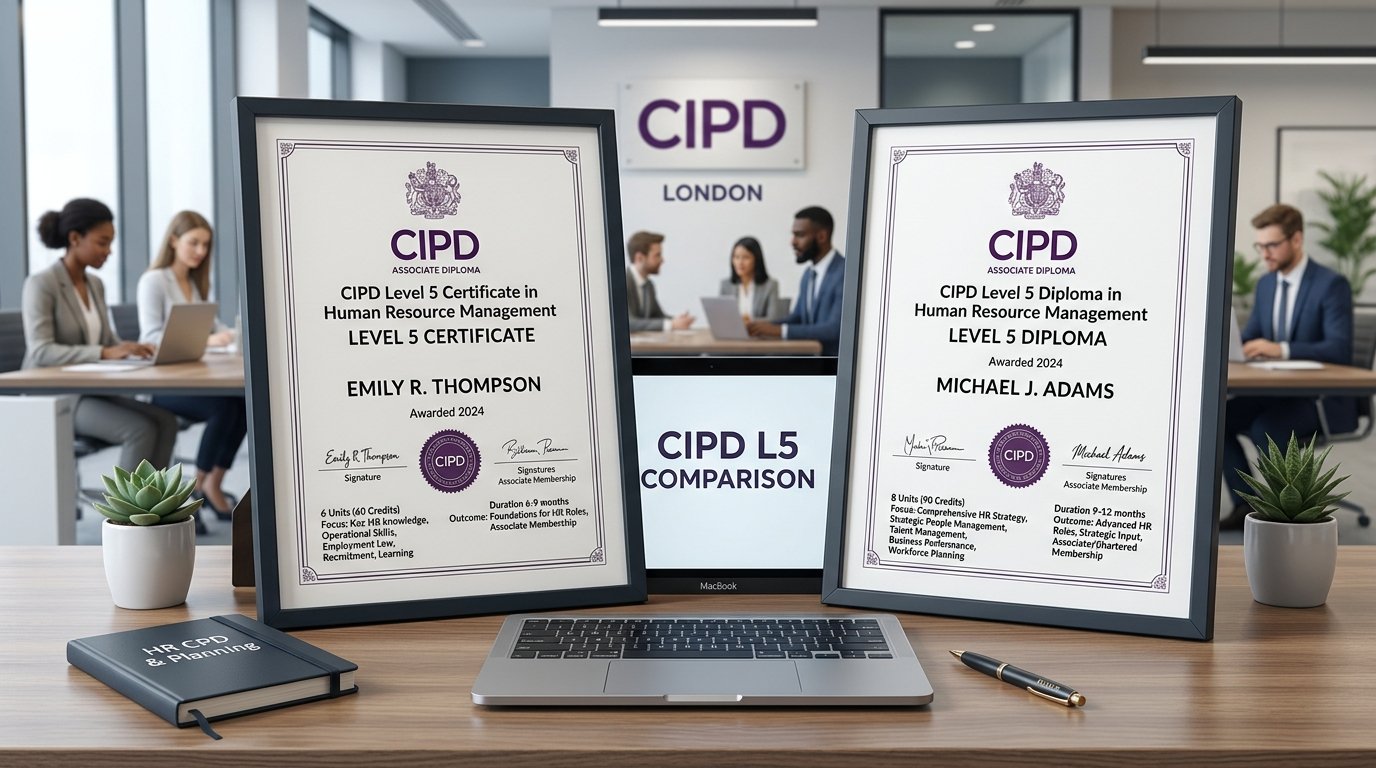
Introduction: Navigating CIPD Level 5 Choices
You might be looking at CIPD Level 5 courses because you want to move forward in HR, get a better role, or finally turn your work experience into a recognised qualification. Then you see Certificate and Diploma and start wondering which one is actually worth your time and money.
It’s easy to get these two mixed up. The names sound alike, but the courses may cover different things.
Before signing up, take a little time to check what’s included in each course and how long it might take to finish. You’ll also want to think about which option suits the HR work you want to do.
Here’s a closer look at the differences to help you decide.
What Is a CIPD Level 5 Certificate?
First, there’s something worth knowing. The term CIPD Level 5 Certificate can mean different things depending on the course being advertised.
CIPD’s current qualification range includes the Level 5 Associate Diploma in People Management and the Level 5 Associate Diploma in Organisational Learning and Development. A certificate might refer to an older qualification, a smaller award or a course offered by another awarding body.
So, don’t rely on the course name alone.
Before enrolling, ask the provider exactly which qualification you’ll receive. Find out how many units it covers and whether you can use it towards a larger qualification later.
This is especially important if you’re already working in HR and want to move up. A short course may help you learn a particular skill, but it might not offer the same coverage as a full diploma.
You can also get support through our CIPD Level 5 assignment help service.
What Is a CIPD Level 5 Diploma?
The CIPD Level 5 Associate Diploma is designed for people who want to develop their knowledge of HR or learning and development.
Perhaps you’re working as an HR assistant and want to take on more responsibility. Maybe you already help with recruitment, employee relations or staff training. You might feel ready for the next step, but you need to build your knowledge first.
That’s where the diploma can help.
The People Management route covers areas such as organisational culture, employee relations, talent management and reward. You’ll also learn about evidence-based practice and professional behaviours.
For more details, explore our CIPD Level 5 Evidence-Based Practice study guide.
According to CIPD’s official qualification information, the diploma includes three core units, three specialist units and one optional unit.
It’s a substantial qualification, so expect to put in some work. You’ll need to understand the topics, complete assessments and apply what you learn to workplace situations.
The good thing is that much of the subject matter relates to real HR challenges, not just textbook examples.
CIPD Level 5 Certificate vs Diploma: What Is the Difference?
The main difference comes down to the exact qualification on offer.
A certificate may cover a smaller number of units or focus on one area. The current Level 5 Associate Diploma follows a broader structure and covers several aspects of HR or learning and development.
Here’s a quick comparison:
| Feature | Level 5 Certificate | Level 5 Associate Diploma |
|---|---|---|
| Qualification | Depends on the specific award / legacy specification | Current CIPD Associate-level qualification |
| Course Content | May cover selected topics or units | Seven units across core, specialist and optional areas |
| Study Time | Depends on the course (often 6–9 months) | Typically 12–16 months |
| Main Focus | May suit a specific learning need | Builds broader HR or L&D knowledge |
| Further Study | Check with the awarding body | Check the available progression route (CIPD Level 7) |
A certificate doesn’t automatically equal a diploma. It depends on the awarding body, credits and what the course covers.
If two providers use different course names, check what each qualification includes before you decide.
Which Qualification Should You Choose?
Think about your needs, not just the course name.
A certificate or shorter course may suit you if you want to learn about a specific HR topic. It may also be a better option if you have limited time to study or aren’t ready to commit to a longer programme.
The diploma may be a better fit if you already have some HR experience and want to build a wider range of skills.
For example, if you’re hoping to move from an HR support role into an HR adviser position, having a broader understanding of employee relations, organisational needs and people management could be useful.
Still, don’t assume that getting a diploma will guarantee a promotion. Employers look at experience, skills and the needs of the role, too.
Take a look at job adverts for the positions you want. What qualifications do they ask for? What skills keep appearing? That can give you a much clearer idea of which route makes sense for you.
If you’re studying alongside work, HR assignment help may also support you to manage your coursework.
CIPD Level 5 Qualification Requirements
Entry requirements vary between study centres, so check them before applying.
Some providers may recommend previous HR experience or a related qualification. Others may consider your background and whether the course suits your goals.
You’ll also need to think about how you’ll manage the course with your daily routine:
- Do you work full-time?
- Will you have time to study after work?
- What happens when work gets busy?
It’s worth thinking about this before you enrol. Ask your provider about assignment deadlines, tutor support and how the classes work. That way, you’ll know what you’re signing up for.
CIPD Level 5 Diploma Cost and Duration
Time and cost matter, especially if you’re paying for the course yourself.
The CIPD Level 5 Associate Diploma usually takes 12–16 months to complete, with typical UK course fees ranging from £1,600 to £3,600.
These are guide prices. The actual cost depends on your chosen provider.
When comparing providers, ask what the fee includes. Are learning materials and assessment support covered? Are there any extra charges? Is CIPD membership included, or will you pay for it separately?
It’s also worth comparing study formats. Online learning can give you more flexibility, while scheduled classes may help you stay on track.
And be realistic about your budget. The cheapest option isn’t always the best choice if you later discover that important support costs extra.
A little research now can save you a headache later.
Your CIPD Journey, With the Right Support
Choosing between a CIPD Level 5 Certificate and Diploma is one thing. Keeping up with assignments while juggling work and daily life is another.
If you’re finding your assignments hard to manage, CIPD Assessment is here to help. We offer assignment help for all CIPD levels at affordable prices, with on-time delivery and support based on your needs.
Got a CIPD assignment you’re struggling with? Visit CIPD Assessment to see how we can help make your studies more manageable.
Frequently Asked Questions
Not always. It depends on the qualification, the units covered and the credits you earn. Check the exact course details before you enrol.
It usually takes around 12–16 months. The time can vary depending on your study routine and the provider you choose.
Fees can range from £1,600 to £3,600. The final cost depends on your provider, so check whether there are any extra charges before signing up.
The CIPD Level 5 Associate Diploma in People Management has seven units in total. These include three core units, three specialist units and one optional unit.
Yes, many people study alongside a full-time job. It helps to make a weekly study plan and check your provider’s deadlines so you can keep up with your assignments.