

You've read the brief three times. You know what the question is asking. But sitting there staring at a blank Word document, you have absolutely no idea how actually to start the answer. How long should this section be? Are you writing analytically enough, or just rambling?
Balancing a full-time job with studying for your Foundation Certificate in People Practice is tough enough without having to guess what the CIPD assessors actually want from you.
I see this all the time. This guide gives you the exact CIPD Level 3 assignment structure framework used in over 1,400 passing UK submissions. Let's break it down, unit by unit, so you can get this done.
Why CIPD Level 3 Assignment Structure Matters More Than You Think
Before diving into what can help structure your assignment, let's first break down why the structure of the assignment matters more than one can think.
Let's be brutally honest for a second. The CIPD Level 3 is a strict pass or fail. There is no "merit" or "distinction" safety net to catch you if your writing goes slightly off-topic.
Assessors in the UK mark directly against specific learning outcome criteria. Sometimes it's not the knowledge or lack of expertise that fails them, but it's because their structure is a mess. Candidates just end up describing the situation in the workplace instead of actually analyzing it.
However, if your brief is clean, has a logical structure, and is well analyzed, the assessor will have a positive impact before they've even finished reading your first page.
| What Assessors Look For | What Most Students Submit | The Gap |
|---|---|---|
| Situation Analysis | This is what HR does | Missing the analytical layer |
| Learning outcome addressed | General overview of the topic | Not mapped to the actual brief |
| Workplace example applied | Textbook definition from the portal | No practical UK application |
| Harvard referencing throughout | Reference list dumped at the end | Missing In-text citations |
| Word count within 10% range | Over or significantly under the limit | The suggested criteria weren't addressed |
How to Structure Your CIPD Level 3 Assignment Answers
Here are the steps to structure your CIPD assignments the authentic way.
Step 1: Decoding the Assignment Brief With Command Words
Command words dictate your entire approach. Treat them like road signs. However, understanding these words is half the battle. You must also take into account the stage at which your assignment is and what each command word actually means.
| Command Word | What It Means | What Your Answer Must Actually Do |
|---|---|---|
| Identify | Name or list | State clearly, keep it brief and specific. |
| Describe | Give details | Explain what it is, its main features, and how it works. |
| Explain | Give reasons | State the concept + give a reason + provide an example. |
| Analyse | Break down and examine | Look at the "what," the "why," and the "so what." |
| Evaluate | Weigh up strengths/weaknesses | Argue a position backed with evidence. |
Our qualified UK writers build every answer around this framework, mapped exactly to your brief. Get a quote.
Step 2: Use The PEEL Framework to Structure Every Paragraph
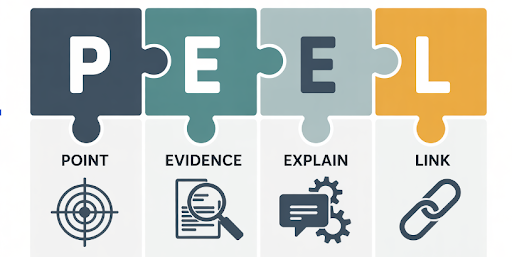
The PEEL framework is a reliable way to write every paragraph analytically. In this framework:
- P stands for Point
- E stands for Evidence
- E stands for Explain
- L stands for Link
Still confused? This table will help you understand much better.
| PEEL Step | Purpose | The Common Mistake |
|---|---|---|
| Point | State your argument directly | Starting with vague background context. |
| Evidence | Ground the point in theory/data | Using CIPD Knowledge Hub as your only source. |
| Explain | Show the "so what" | Just dropping a quote without explaining its relevance. |
| Link | Tie back to the question | Ending the paragraph abruptly without reconnecting. |
With this structuring strategy, you can ultimately access your assignment.
Step 3: Targeting Each Unit Individually
As we know, CIPD Level 3 has 4 units, and every unit in the syllabus tests a different skillset.
- 3C001 (Business, Culture and Change): Always link external factors from your PESTLE analysis back to people practice. Don't just list UK inflation rates; explain how inflation changes HR reward strategies in your specific company.
- 3C002 (Principles of Analytics): Show the data, then interpret it. Assessors want to see you actually use evidence, not just talk about what evidence is.
- 3C003 (Core Behaviours): This unit is highly reflective. Reference the CIPD Profession Map explicitly to show professional awareness. Talk about your own behaviours.
- 3C004 (Essentials of People Practice): This is the heavy lifter. It covers the whole employee lifecycle. Make sure every single section from recruitment to exit includes a real, tangible workplace example.
| Unit | Focus Area | Structure Priority | Approx. Word Count |
|---|---|---|---|
| 3C001 | Culture, change, external context | PESTLE + people practice link | ~1,500 words |
| 3C002 | Data and analytics | Evidence + interpretation | ~1,200 words |
| 3C003 | Professional behaviours | Reflection + Profession Map | ~1,200 words |
| 3C004 | People practice essentials | Employee lifecycle + real examples | ~2,500 words |
Stuck on a specific module? Look into targeted CIPD Level 3 assignment help UK online to get back on track.
Step 4: Apply Harvard Referencing
Referencing shouldn't take up half your weekend. Referencing is strictly checked, so keep these three rules in mind:
- In-text citations are mandatory: They go inside your paragraphs, not just in the bibliography at the very end.
- Use multiple sources: Don't just rely on the CIPD portal. Pull from ACAS, Google Scholar, or the ONS to show actual depth.
- UK legislation has its own format: When citing UK employment law, it's remarkably simple. No author surname needed.
| Source Type | Examples | Reference List Format |
|---|---|---|
| CIPD report | (CIPD, 2024) | CIPD (2024) Title. London: CIPD |
| Journal article | (Smith, 2023) | Smith, J. (2023) Title. Journal, Vol(Issue), pp.x–x |
| UK legislation | Employment Rights Act 1996 | Employment Rights Act 1996 (c.18) |
| ACAS guidance | (ACAS, 2024) | ACAS (2024) Title. Available at: URL |
Common Mistakes That Cost Students Their Pass

Avoid these traps, and your chances of passing the first time skyrocket.
- Describing instead of analyzing: You explain what HR does, rather than why it matters to the business.
- Ignoring command words: Treating an "evaluate" question like a simple "identify" list. That's an instant referral.
- Zero workplace examples: Assessors want to see how theory works in your actual UK office, not just in a textbook.
- Reference list only: Forgetting to put citations directly in the text body.
- Word count violations: Going way under means you missed assessment criteria; going way over looks like panicked padding. Stick to within 10%.
When Self-Study Isn't Enough: How Expert Help Works
Let's be honest, many CIPD students are already working 40-hour weeks, managing families, and trying to squeeze studying into their Sunday evenings. Sometimes, self-study just isn't enough to get over the finish line.
While downloading a free CIPD Level 3 PDF can give you a rough outline, it cannot write your workplace examples or structure your citations, and a personalised approach is always a safer yet better option.
This is where expert CIPD writers come in. Professional services provide answers that are perfectly mapped to the assessment criteria, fully referenced, and tailored to the Profession Map. Plus, they offer on-time delivery, even if you are panicking about a deadline that's 48 hours away.
If you are looking for reliable support that understands the syllabus inside out, cipdassessment.com has helped hundreds of students pass the first time.
Key Takeaways
- Decode the brief first: The command word (Identify, Explain, Evaluate) dictates your entire approach.
- Use the PEEL method: Structure every single paragraph with Point, Evidence, Explain, and Link. It stops you from rambling.
- Unit-specific focus: 3C001 needs a PESTLE link to HR, while 3C004 requires a full employee lifecycle overview with heavy use of examples.
- Don't skip in-text citations: Harvard referencing applies throughout the whole document, especially when citing ACAS or UK laws.
You now have the framework. But what's next?
The hardest part is actually applying it to your specific brief under time pressure while working a full-time job. Our UK-based, CIPD-qualified specialists have delivered 1,473+ Level 3 assignments, each structured exactly to the criteria your assessor uses.